
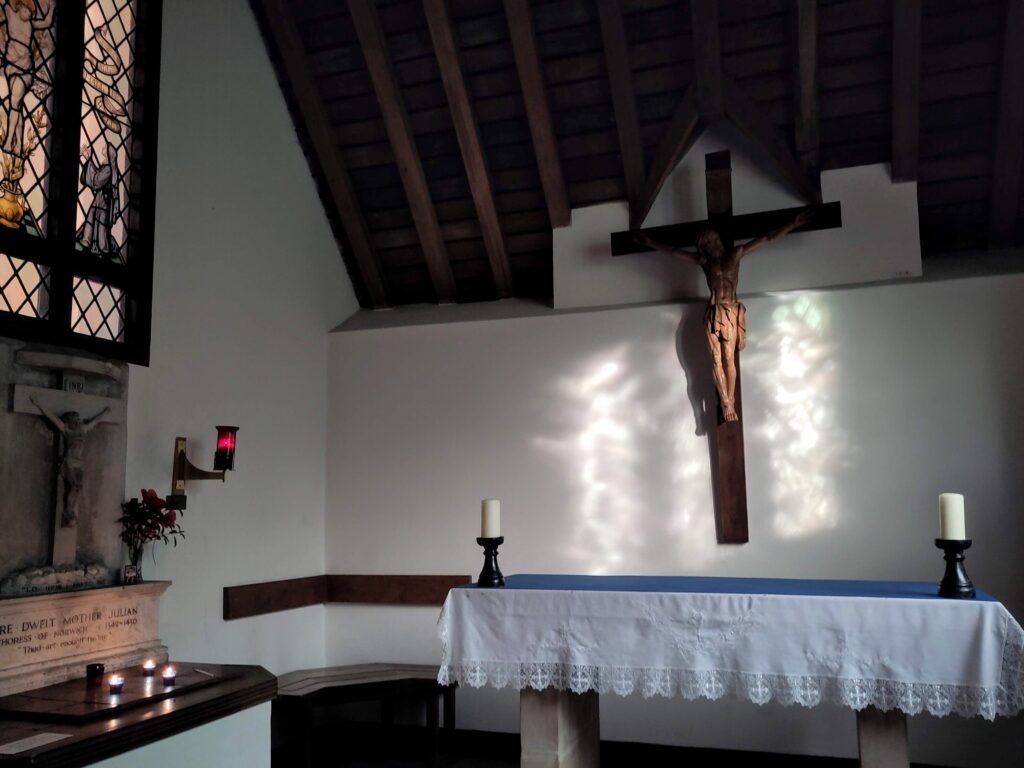
I always enjoy walking around Norwich, where so many medieval buildings still survive, unlike in most English cities. A short walk from the main train station and up a narrow alleyway from the river Wensum brings me to St Julian’s Church, a place I always visit when I’m in the city.
It’s a small ancient church dating originally from the 11th century; the place where Lady Julian spent her entire adult life in the 14th century after a series of spiritual visions, following a life threatening illness. She lived in a small cell adjoining the church.
I sit on a bench in this cell where Julian lived and wrote her spiritual classic, Revelations of Divine Love, the first book ever written in English by a woman. Sitting alone on a freezing November day in this small shrine room, the depth of peace and presence is palpable and I forget all about my previous feelings of coldness.
She was an anchoress, one of those Christian ascetics who withdrew from regular life to live a life of prayer and contemplation, sealed in a small cell called an anchorhold, attached to a church. Unlike hermits who withdrew from society completely, and could wander around, anchorites were required to take a vow of stability of place, opting for permanent enclosure in their anchorhold attached to a church. From there, they provided spiritual advice to the community through a small window in the cell and were much valued in medieval times, there being anchorites attached to a number of churches in Norwich and throughout the land.
Lady Julian in particular, was renowned for her passionate love-filled guidance in those dark times of the Black Plague and the Peasants’ Revolt in the 14th century. Her message, born of ecstatic realisation, was not one of sin and punishment, but of radical love.
The church has become a pilgrimage site with a small retreat centre nearby, though it is quite hidden unless you seek it out. I’ve sat in the church and the adjacent cell by myself several times, lighting a candle at the shrine and I’ve felt the sacred energy easing me into depth and gratefulness.
I’m fascinated by the idea of ‘anchorholds’ and it gives me a sense of how this sacred site with its stability and influence through time, somehow anchors the city and imbues it with deeper meaning – at least that’s how it feels to me.
“All will be well, and all shall be well, and all manner of things shall be well…. For there is a Force of Love moving through the universe that holds us fast and will never let us go.”
St Julian
This recent experience made me contemplate a regular occurrence of mine when I’m out hiking. I always stop in at the ancient churches that I happen to come across in villages or out in the middle of nowhere, where the church may be the only remains of previously existing habitations. And I usually leave feeling stilled and more deeply connected to life.
They are repositories of history, culture, spirituality and community and are deeply interwoven with the land. To me they all serve as anchors in the land and you can’t deeply understand the country without them.
It’s quite common to find ancient Yew trees growing next to old churches and the Yews often predate the church. Yews, symbols of everlasting life and rebirth, because of their great age and ability to sprout shoots afresh even when the main trunk is declining, made them sacred trees to early pagans long before later Christians continued the reverence. Churches were very often built on preexisting pagan sites, and these were originally chosen for being important sacred places. And our ancestors were far more tuned into the energies of the land and revering special sites.
Rupert Sheldrake explains the connection which can be felt across time with ancestors and with sites which have been places of devotion over the centuries. His theory of morphic resonance proposes that memory is inherent in nature and that collective memory is passed down through morphic fields across time with rituals being a particular way to explicitly access and reinforce this memory. In fact, many cultures throughout the world have always assumed a link between the living and the dead through memory, prayer, and love, a perspective which we in the modern West have largely lost.
I’m reminded of an ancient church on the Dorset coast with its accompanying ancient Yew tree which I stumbled upon recently on a hike. Entering the church, still lovingly adorned with fresh flowers, I could feel the thousand years plus of devotion and was pulled into meditation and communion.
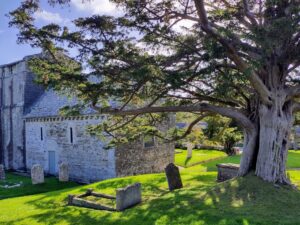
Churches were also built on the sites of sacred springs and wells previously venerated by earlier pagans. So it seems to me that churches could be considered as anchorholds in the land: symbols of history, culture and deep veneration over the centuries. Visiting churches which I pass on my hiking, I recognise this power and rootedness, and it helps anchor me in the living land.
I wasn’t brought up Christian and am not a Christian although I have tremendous respect for the best of Christianity. Yet if you grow up in a Western country like Britain, you can’t help but be very deeply influenced and shaped by the religion which has formed the people, culture, attitudes and landscape over many centuries.
The effect of churches as anchorholds is not confined to rural villages. In the heart of the East End of London is St Dunstans & All Saints, known as ‘The Mother Church of the East End’. I’m always slightly in awe when approaching this ancient church with its history going back over 1000 years. It’s such an unexpected and peaceful oasis in densely built up Stepney. Surrounded by spacious green with an avenue of tall plane trees leading up to the church, it gives me the sense of a bright citadel on a hill though in reality the ground only rises slightly.
I could continue this thread with the majestic and cavernous cathedrals which still humble us with their vertical columns soaring up into the heavens. As I ramble throughout the countryside, all these experiences serve to increase the inherent mystery of dwelling in this storied earth; being at once in past, present and future, our once and future selves.
May we all rekindle the sense of the sacred & Holy within the living landscape.

2 responses
Yes , indeed , on all counts
Wonderful thoughts and considerations Chris. Very enjoyable read. Possibly a potential book in the making… 🙂