
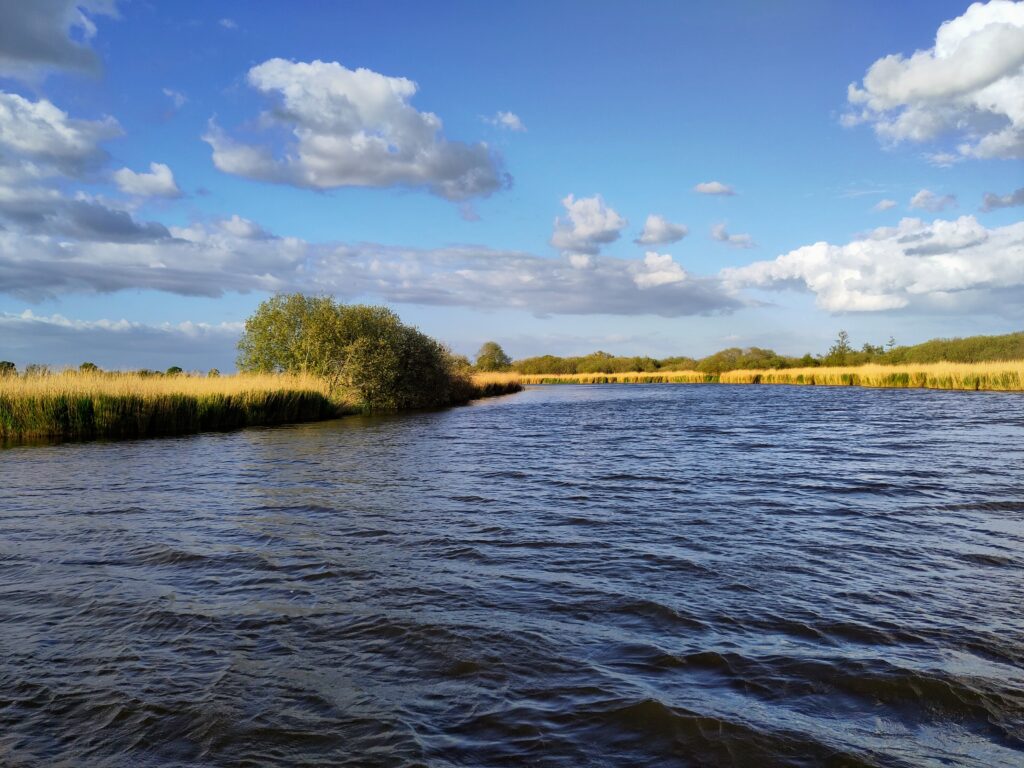
Slipping through the reed-banked channel of the river on our small boat, I feel distinctly in rather than on the river. Every few yards herons sit like statues on overhanging branches or on the river bank, while overhead terns patrol the watercourse, suddenly diving from a height to catch fish. I appreciate why they are nicknamed ‘sea swallows’, with their pointed wings and rapid flight.
All around from the fringing reed beds, comes the constant mad chattering of reed and sedge warblers, while they remain invisible apart from rare glimpses. Swifts dash and scream overhead, as they catch flying insects. The call of the cuckoo echoes hauntingly across the marshes. I look for the birds but often can’t find them or only get a glimpse of one sitting in a distant dead tree. Nothing chimes the Spring season in late April and May like the call of the cuckoo.
All this life is contained in the watery domain and I feel I’m entering into the life of the river, which includes the whole watershed.
Here we are on a week’s trip into the Norfolk Broads, that interlaced network of rivers, dykes, lakes and channels, in a vast watery landscape filled with waving reedbeds. With enough food and water for the trip, we are able to moor up in less frequented and out of the way tributaries, far from roads, shops or riverside pubs.
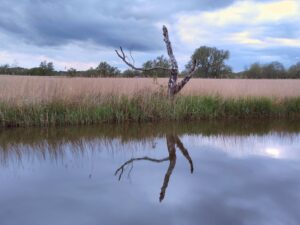
For many years the lakes, known as broads, were regarded as natural features of the landscape. Only in recent times has it been revealed that these lakes are from flooded medieval peat excavations. Peat, an important fuel source, was extracted back then and the workings became flooded as sea levels rose, leaving today’s Broads landscape with its reedbeds, grazing marshes and wet woodland.
Like the majority of waterways in Britain, the Broads rivers have been grievously wounded by pollution from agricultural runoff and although here they are starting to heal, I see the difference when we come upon those rare lakes and ponds which have remained pristine. Here in crystalline water, rare aquatic plants burst in abundance, such as water soldiers, those strange floating spiky plants resembling the tops of pineapples
The currents here run slow in the flat landscape, with no dramatic white water or roaring waterfalls, and can initially appear underwhelming. Yet I soon find that river exerts her influence on us in more subtle and yet profound ways. The effects seep in gradually as we abide in the slip-slopping flow which gurgles against the boat sides; the river current mingles and swirls with the rhythm of more distant tides downstream .
When lying in the small cabin, I’m almost at river level and can watch ducks float by or listen to them as they sit quacking on the cabin roof. With the big skies and scarce human habitation, there is little light pollution and the night sky brims with stars, a boon for my star-starved city eyes.
At night I find myself falling into very deep dreamless sleep and in the mornings, I strangely can’t open my eyes for about half an hour in spite of trying . And my mind is utterly silent and peaceful, as is my body. I feel as if I’ve been absorbed into the river bed, almost comatose. I half jokingly refer to my state as ‘peat consciousness’.
Like the river, human beings are also waterbodies, which might partly explain the affinity and absorption in our shared fluid state.
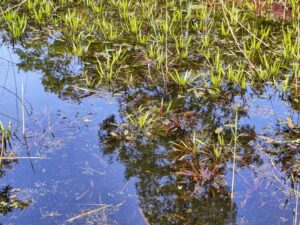
Water soldiers proliferate in pristine waters
I took Robert Macfarlane’s, Is a River alive? book to read on the trip, but was so absorbed in just being in the river system, that I didn’t read much. It’s a good catchy title, PR-wise, though it’s clear to me (as it is to Macfarlane too) that the answer is obviously in the affirmative. To accord rivers the dignity of subjects, we should refer to them as rivers who flow, rather than which flow.
We were blessed to have good close views of that famously elusive being: an otter, who nonchalantly carried on swimming down the river, with no reaction at all to our presence.
We thanked the rivers and broads for their welcoming hospitality before we returned to terra firma again. The silencing of the mind effect continued just as strongly after leaving the Broads and returning home, leaving me feeling that my consciousness had somehow been flowed into and washed in the rivers.
I can join Macfarlane in saying, I am rivered.
5 responses
Lovely evocation of the Broads, Chris. ‘Well-rivered,’ I wanted to add at the end. Definitely makes me want to go there.
What a simple joy to drift on the water and meet new plants, birds and wildlife in your sweet prose Chris, You remind me of the Zen poetry of Ryōkan;
“I never longed for the wilder side of life.
Rivers and mountains were my friends.
Clouds consumed my shadow where I roamed,
And birds pass high about my resting place.”
Thanks Patrick! I guess it does have a Ryokan quality about it. I’m flattered!
Lovely piece about the Broads. It’s a magic place and you have captured that magic.
Lovely, evocative writing, as ever