
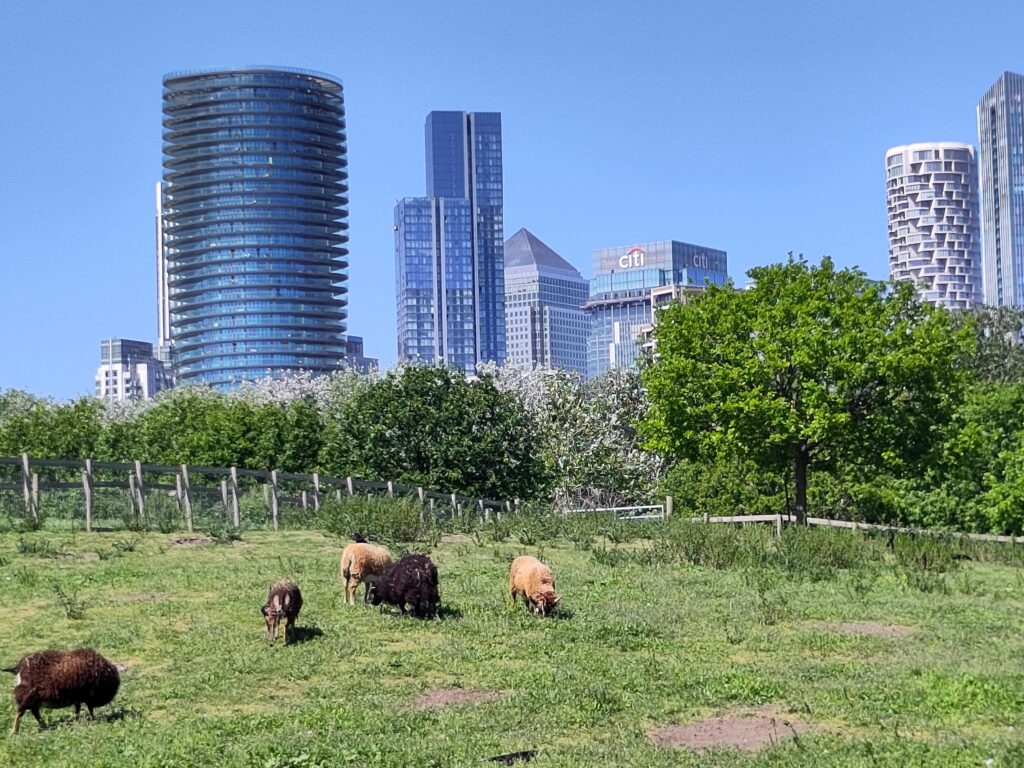
No, the above is not an AI photo. It’s real life in my local area in East London where skyscrapers loom over the urban farm with rare breed sheep grazing and a surprising variety of wildlife calling the unkempt acres home. And this is my habitat too: here in this urban sprawl mixed with green and brownfield spaces.
I’ve written many essays/blogs over the last few years covering a wide range of topics from Nightingales to Soul Loss to Our Lost Sense of Smell, all under the banner of ‘The Urban Animist’. Yet there is a recognisable uniting thread behind many of them which I will explain.
I’m often asked what kind of writer I am, and I tend to say for simplicity’s sake that I’m a ‘nature writer’. But for myself, I feel I need to qualify that answer as I feel ‘nature writer’ tends to give the wrong impression. I don’t write about ‘nature’ – at least I try my hardest not to. Instead, I attempt to write from my ongoing experience and immersion in ‘nature’. Interestingly, traditional indigenous peoples often don’t have any word at all for ‘nature’ since they live inseparable from the earth.
As for the ‘Animist’ part of my website title: animism can be said to be the simple intuition that everything is alive, that everything has its own interior animation, its own pulse and rhythm; that each thing has a degree of agency and ability to affect the space around it. We don’t actually live in an inanimate world full of separate ‘things’. ‘Anima’ comes from the Latin for spirit, breath or soul. (generally speaking, disposable human artifacts with no genuine connection to their surroundings are considered to be inanimate).
I find it a fascinating creative challenge to attempt to write from this animist sensibility, since we modern people are so deeply encultured to see ourselves as observers apart from our surroundings. The English language is not structured in such a way as to easily support this change in perspective. There are subjects (us) and objects (the largely inanimate rest) and never the twain shall meet.
So that’s the challenge: to find a way to write from a more participatory embodied perspective: one that honours the life and sacrality of our shared existence in this extraordinary world.
I emphasise the ‘urban’ aspect in many essays because that is where the majority of people in the world, including myself, now live. For most of us, a relationship with the wild is going to take place in urban, edgeland and brownfield settings, rather than in exotic rainforests or coral reefs. Yet wildness, rather than wilderness, can be found anywhere.
My writing is born from untold hours of walking and sitting and just being immersed in these edgeland wilder spaces. And this is coupled with a long cultivated habit of becoming more interested in simply perceiving directly when I’m out wandering rather than thinking about anything in particular.
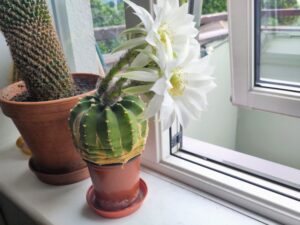
I open the curtains this morning and am stunned: overnight the cactus on the window ledge has grown resplendent white flowers out of nowhere; how mind-stoppingly miraculous!
When I step out into the sunlight, I feel the warmth on my face; that feeling is of experiencing sunlight’s nature itself; relating to sunlight directly, and who’s to say that sunlight isn’t simultaneously experiencing us? I greet the wood pigeon sitting on our balcony wall as a friend and gaze up at the sumptuous clouds, ever changing in the breeze.
A simple walk round the block is ever new as I appreciate the changing seasonal beauty of the leafy street trees I know so well.
The lapping, glistening waters of my local dockside speak to me of depth and movement as the breeze kisses and ripples the surface. I would never doubt the beingness of wind and water.
We need to learn the grammar of animacy in the words of Potawatomi Nation writer and botanist, Robin Wall Kimmerer. As she says,
To be native to a place we must learn to speak its language.
It’s a different lens from the Western one in which we’re deeply embedded.
English is a noun based language – a language of ‘things,’ while indigenous languages tend to be full of verbs – of being and doing. For example, freeing rivers from the utilitarian sense of being merely channels of water to be dammed or extracted from as ‘natural resources’, allows rivers to be verbs and to do and have their own being and agency. Hence rivers’ claim to have rights to flow freely and not be poisoned. A lot rests on this shift in our worldview.
And attitudes are beginning to change. Just this month the river Wye which straddles the English and Welsh borders has been recognised by the county councils covering the catchment region, as having intrinsic rights to flow, to be free of pollution and to be represented.
This is not to discount the great value of our Western rational and cultural lens, but it’s certainly not the only lens, and an animistic view can open up so much more about life and living. For example, we reserve the pronouns of personhood of ‘he’ and ‘she’ for humans only, and not for animals, plants, rivers and landscapes. So everything except we humans is reduced inadvertently to a multitude of ‘its’ or ‘things’; and when they are all merely ‘its’, we are unlikely to feel any sense of care or moral responsibility to these inanimate ‘its’. Instead of relating to the earth through extraction, the fundamental shift in mindset that I’m pointing to, can lead us to relate to the life world through kinship, respect, and moral responsibility.
Indigenous cultures the world over have always seen the world as alive and with agency. Young children have a similar mindset and naturally talk with animals until they become re-educated into our grown up and ‘sensible’ outlook.
Why do I feel so passionately about the value of sharing this more animistic and participatory perspective? Simply because we are currently destroying the very living systems on which all life, including ours, depend upon. And if we don’t emotionally feel ourselves to be an integral part of Mother Earth, then we are unlikely to be motivated to do anything about it. We won’t protect what we don’t love. It’s that simple.
5 responses
Amen to that Chris! Amen to that!
Thankyou Chris for the nudge, the embodiment and the joy.
Ngā mihi, Tom
Indeed!
So it is .. thanks , as ever, for the reminder 🙏
My first response to the photo was OMG … those ghastly skyscrapers! But the rest of your post gave hope. Keep writing!