
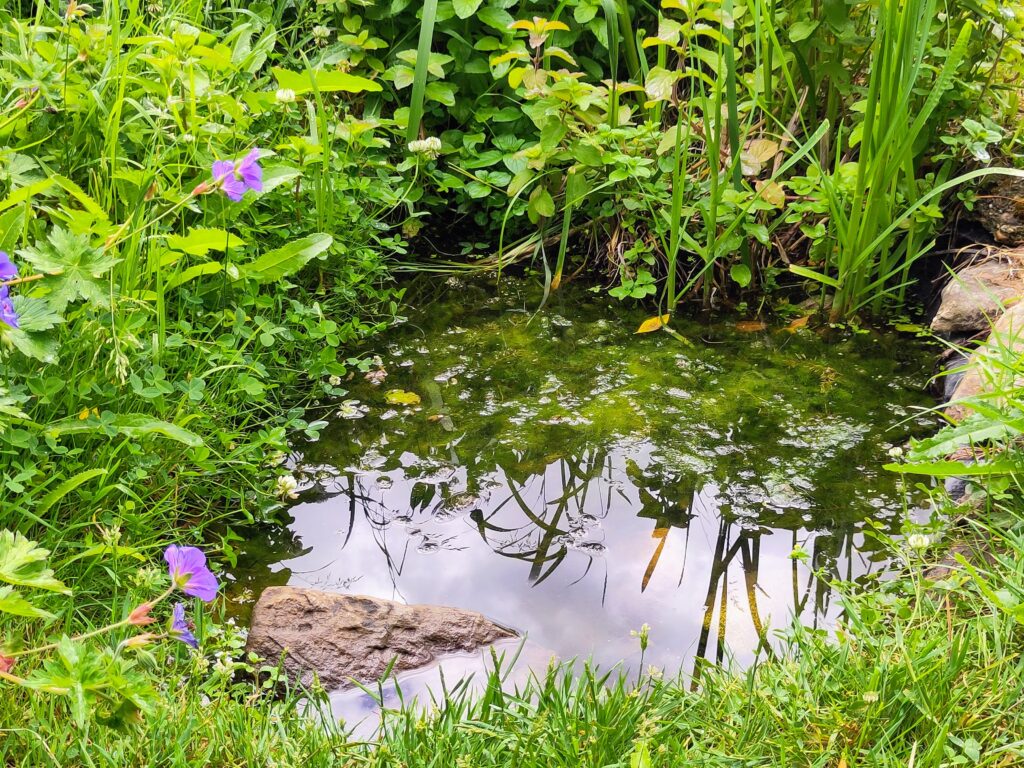
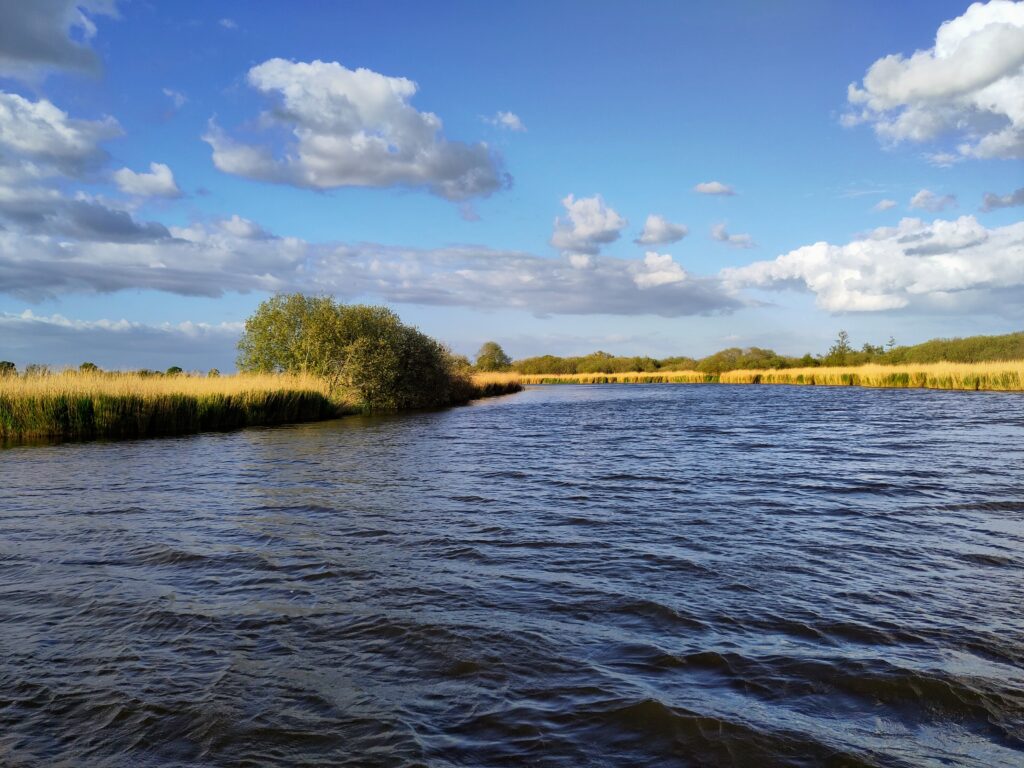
Sitting gazing at the tiny pond on my allotment on a summer evening, the water is unfathomably still and calm. The mirrored surface holds clouds floating beneath the surface amidst shadow reeds.
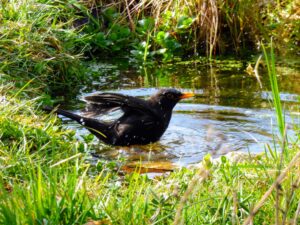
A blackbird alights on the edge and bathes in the cool water, splashing jewels of liquid silver all around and the clouds are gone. Enjoying himself, the blackbird flies up to a nearby branch to shake off the water and dry his wings.
And the pond returns to its mirror nature, inviting the clouds back again.
I often sit in the shade on my bench by the pond, simply present – or maybe absent in some important sense. I’ve written about the value of such regular sit spots previously. Being present like this through the changing seasons, there’s the bare pond in winter, even frozen over occasionally, when I break the ice to enable the birds to drink; then the spring greening followed by summer fullness with all the rich and varied details of each season.
I’ve often mentioned how it’s not about observing, but rather an immersion in the whole reality of which we are a part. I’ve long been drawn to ancient Chinese mountains-and-rivers poetry for what I recognise as a similar sensibility. This poetry blends Daoist and Buddhist philosophy in its expression of the vastness of nature and the cosmos. It conveys a profound and spiritual sense of belonging to the wild. In contrast, the word “nature” suggests a false dichotomy between nature and human, and the usual English term of “landscape” suggests a picture which is observed from the distance of a spectator.
I find that this ancient poetry, originating from the 5th century CE onwards, still feels extraordinarily contemporary. Typically set in the wilds of mountains and rivers, though many poets expressed the same worldview while writing of everyday, seemingly mundane occurrences. This poetry has helped me to give voice to the depths of my experience in seemingly inconsequential small natural occurrences.
Talking of my small pond, I chanced on this short poem on the same subject from the 12th century Sung dynasty.
The Small Pond
A spring’s eye of shadow resists even the slightest flow
Among tree shadow, its lit water adores warm clear skies
Spiral of blades, a tiny waterlily’s clenched against dew
and there at the very tip, in early light, sits a dragonfly
Yang Wan-li 1127- 1206
At first sight, the poem can appear from a Western standpoint to not say very much, though it sounds pretty and peaceful. It helps to know how the poem is informed by Daoist cosmology. Lao Tzu’s Dao originally means Way, but it also means the process through which all things arise and pass away; how nonbeing burgeons forth into being.
The dragonfly sitting on the tip of the waterlily in the poem above conveys the mysterious way in which being appears from nonbeing.
This natural process is most obviously seen in the seasonal cycle of winter to spring to summer to winter, and Chinese poets located themselves in this cosmology by often referencing the seasonal cycle. Not only monks, but poets and artists were usually steeped in Ch’an (Zen) meditation. There was a shared vision of wilderness as the fundamental cosmological model of reality. Here is the radical difference between our Western view which instead places humans firmly at the centre of the world.
For the Chinese poet, it was often about being empty mind, completely occupied by nothing special. The means by which being appears out of nonbeing is called tzu-jan, literally meaning self-ablaze or spontaneous, natural, “occurrence appearing of itself”. This is how the “ten thousand things” (the totality of phenomena) emerge spontaneously from the generative source, each passing and returning into the process of change. So the perpetual unfolding of the Dao is the flavour of daily experience.
Meditation was at the heart of Daoist-Ch’an practice, leading poets and others, when the stream of thought quietens, to return to empty mind, the generative ground from which everything appears and disappears. In this we can become free of the self-absorbed identity centre that defines us as separate from the world around us.
I’m indebted to veteran translator of Chinese poetry, David Hinton, for explaining the subtleties of Chinese rivers-and-mountain poetry, and how surprisingly relevant it is in our times of ecological collapse.
Once mind is empty and silent, perception becomes a particularly spiritual form of ecological practice: awareness, the opening of consciousness, functions as a mirror reflecting the world with perfect clarity, allowing no distinction between inside and outside. Hence, the ten thousand things become the very content of consciousness, become indeed identity itself. This empty mind mirroring is a celebration of absolute kinship – consciousness become the Cosmos gazing out at itself.
David Hinton, Wild Mind, Wild Earth
So what this comes down to is an everyday attention to the very thusness of things – whether seeing leaves in the breeze, the grandeur of mountains or the blackbird bathing in my tiny pond. Seen like this, it becomes a deep ecological practice, a celebration and an ethically informed view. After all, what’s done to wild earth is done to us.
This kind of seeing will be familiar to many of us in moments when we are suddenly struck by awe or wonder at some expression of beauty. The only difference is that we westerners often habitually focus awe or wonder back to make it mean something about ourselves who are experiencing the awe, rather than the empty mind mirroring of the Chinese poetry tradition.
Meanwhile, I’ve regularly sat at my sit spot on a bench gazing at the tiny pond for more than a decade through all the seasons and it’s still ever fresh.
Let me conclude with a poem from Wang Wei, a Tang dynasty poet celebrated for the way he could make himself disappear into a landscape; empty mind mirroring the world with all the ten thousand things utterly simple, utterly themselves.
Bird-Cry Creek
In our idleness, cinnamon blossoms fall.
In night quiet, spring mountains stand
empty. Moonrise startles mountain birds:
here and there, cries in a spring gorge.
Wang Wei 701-761
Poems The Small Pond and Bird-Cry Creek from David Hinton’s excellent poetry anthology: Mountain Home

6 responses
I like the differentiation you make about experiences of awe that we humans most often take to mean something about us as a separate person; whereas if we are lucky enough, or practiced enough, we might find ourselves stepping into that larger realm where who we are disappears for a while and we are somehow walking or standing or sitting in profound peacefulness with other beings – the birds, the tiny flowers in the lawn, the breeze that sweeps up around us, the trees slowly swaying. Its not a meditation we find: more a wide-eyed doorway into a living world…These times can’t be held to take back into the humdrum normal world. Instead they are to be honoured in the moment, maybe seeping into us. That world remembers me, and I IT, and the passage becomes easier.
this is beautiful Chris. Your experience of the pond now lives a little in me. And the poetry is a revelation. thank you. Sublime.
Thank you Annie!
Beautiful Chris! Your reflections are so true to the essence of the ancient poetry… (I often wonder if these past times were unusually wise – unlike our own). The understanding of mind through meditation is communicated through this sparse and essential poetry – where language was used not to describe (and so create distance) but to evoke and mirror reality through emptiness. A real joy!
I do think – from what I’ve read – that in certain periods of ancient China, wisdom was cultivated and greatly valued among at least some strata of their society such as monks, artists, poets, philosophers
Beautiful piece Chris. Thank you! You capture the collapse between subject and object which, so often, as you say, is imposed on our relationship to the wild beauty around us creating a false distance. I love that you bring the mountain-river dharma to life in your description of your little pond and the life around and in it.
It’s interesting and humbling that the ancient Chinese Daoists understood the essential, indivisible nature of man and the environment we are part of, and simultaneously inhabit.