
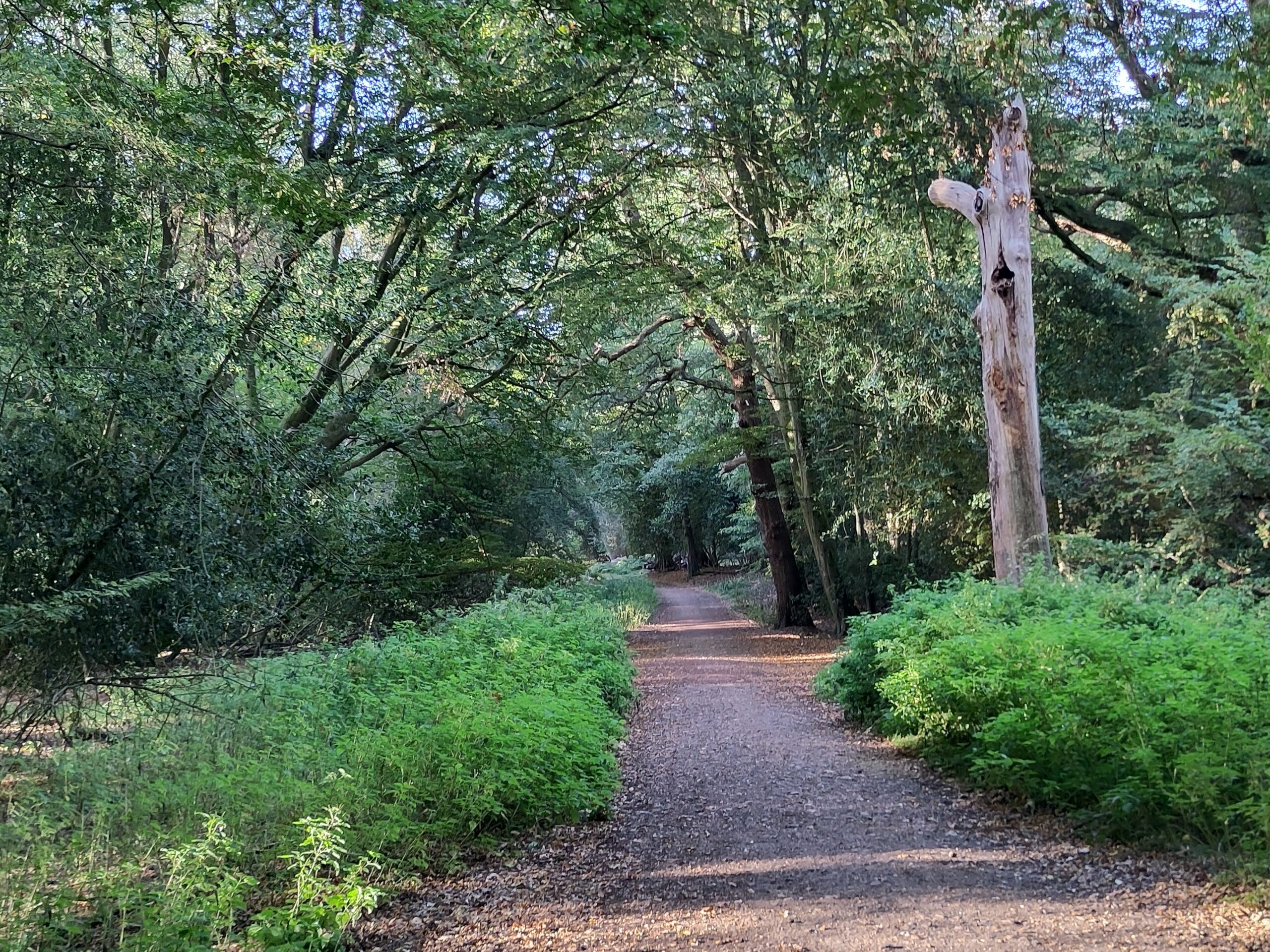
It was a lovely, cool early autumn day. The sun was up, but it was still quite chilly in the early morning as I set off for a hike in my nearest forest: Epping. Fortunately, I can easily get out to the ancient Epping Forest, since the forest extends southwards into the north eastern London boroughs. I can take public transport out to the far side of the forest, and then it is a lovely eight-mile walk, totally through the broadleaf woodland and off-road, to reach the southern edge and catch the train home again.
The leaves are starting to drop early from the predominant hornbeam, beech and oak after the long summer drought. The streams have dried out, and the ponds are much shallower too, or even dried up.
Entering the forest, I feel I can breathe deeper and I inhale that rich earthy scent of the woodland humus. It’s now known that in doing so, you’re inhaling airborne molecules containing phytochemicals which cross into your bloodstream through your lungs, initiating a series of measurable biological benefits. You are quite literally taking the forest into your very blood; you cannot get much closer than that, even if we don’t usually realise it.
Once I entered the forest, I was struck by the welcoming green canopy and I felt a strong impulse to introduce myself. I thanked the forest out loud for letting me walk through, expressing my gratitude for the peace and welcoming atmosphere it provides to everyone and wishing it well. At first, I felt slightly embarrassed to be speaking out loud like this, even though there was no one around for miles, early in the morning. But it felt right to do it; feeling that gratitude, asking for permission to pass through, and commiting to walking gently and with love.
Obviously, the forest cannot answer back in human language. Yet, I had not gone far down the path when suddenly, I came face-to-face with a beautiful fallow deer standing right in the middle of the trail in front of me, quite close by. It felt as though she literally materialised on the path. I make a point of being attentive to all the sights and sounds when I’m out walking, yet I had no prior warning of this almost magical materialisation.
The beautiful animal stood quietly still, and we gazed at each other in silence. We met right there in that stillness. There was no fear and no hurry. We looked at each other, and after a while, she silently moved off the path and disappeared back into the greenery without a sound—not a cracked twig or any rustle of leaf litter.
In that moment, I felt answered and welcomed by the forest in an extraordinary way. It felt like the forest was responding and it felt deeply significant and meaningful to me.
You could say it was just a coincidence, but it was odd. I’m very familiar with fallow deer and have often seen them. Female fallow deer like this one, almost always stay together in a herd; you might meet a solitary stag, but rarely a doe on her own. Furthermore, there was no fear or trepidation. This isn’t a deer park and usually here they are skittish and you only catch a fleeting flash of deer darting through the trees, if you are lucky. But this was different.
Also, interestingly, this doe had a beautiful light tan coat with white spots. In Epping Forest, most of the fallow deer belong to a very dark, melanistic variety. Seeing such a light-colored deer made the event even more unusual.
I continued on with a profound feeling of welcome and a deep sense of connection, not just to the woods, but to everything. It was a sense of encounter, rather than relating to nature through intellectual knowledge or analytical observation. Standing back as a removed observer who tries to note or record things is completely different from a direct encounter where you meet everything face-to-face. Coming into the forest is an encounter.
Starting out, there is definitely a clear goal and a linear path that takes a certain number of hours to travel. But once I am set on the path and walking, I am quite familiar with the different trails in the woods and hardly need to think about the route.
As I walk, I find my natural pace. When you find that natural pace, it becomes effortless. You are not trying to get anywhere, and there is no will involved; it is just happening. Walking is the natural mode for human beings; it is what we have evolved to do. When you walk in that effortless way, there is a natural pace, with no goal and no destination. I am simply walking, with no relationship to the passing of time. I am simply there on the path.
Of course, linear time is just one kind of time. There is another dimension where no time exists at all. And there are also the circular rhythms of the seasons: the leaves are falling, many of the familiar birds have migrated south for the winter, and the light mellows and fades as the season advances. You get that lovely angled light which is not the harsher light of summer but a beautiful, slightly melancholic, stunning autumn glow.
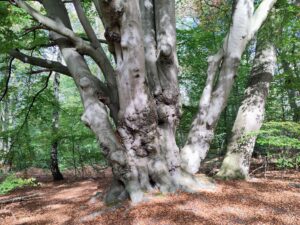
Then there is the deep time of the forest: the ancient trees that have stood and endured for centuries, and the remains of the ramparts of an ancient Iron Age fort, now smooth mounds weathered away over time.
Time exists in all these dimensions at once: linear, circular, deep, and as the eternal moment.
My experience with the deer was a reflection of an actual, reciprocal relationship with the world. It is not just about me and what I feel inside; it is about calling for and receiving a response from the world. It is what environmental philosopher Freya Mathews calls an ontopoetic relationship; a way of relating that indigenous societies have lived by throughout history and continue to practice today.
I realised afterwards that in my greetings to the forest on beginning this hike, I was making an invocation to the whole forest. In my poetic address, I was inviting a response, and when it was reciprocated in the form of the deer, I was deeply moved.
It seems that when humans approach nature or place with authentic, wholehearted poetic intent, the living environment responds through synchronicity, imagery, and meaningful coincidences. Ontopoetics is this kind of practice which calls reality into active presence and invites it to collaborate with us in the making of meaning. Human societies throughout the ages have always believed that the world is responsive to us in these ways, when invoked with respect and reverence.
Freya Mathews expresses the profound shift in allegiance that such experiences can catalyse:
When the living cosmos responds, in person as it were, to our poetic address, in terms referenced to the particular idiom of our invocation, we feel so intimately and extravagantly blessed, so moved and shaken on our metaphysical moorings, that our allegiance henceforth will be first and foremost to this cosmos itself, generally under its local aspect, the place or physical context which provides the lexicon of revelation. Love of world in this sense becomes our deepest attachment. It replaces self-love as the root of our motivation.
The rest of my hike through the woods was accompanied by a deep sense of attunement, a sense of being a part of the woods, inside them, as if a veil had been lifted.
Coming to the forest edge, I turned and sincerely thanked the forest and wished her well.

One Response
forest-bathing to the max!