
Learning from cats and dogs
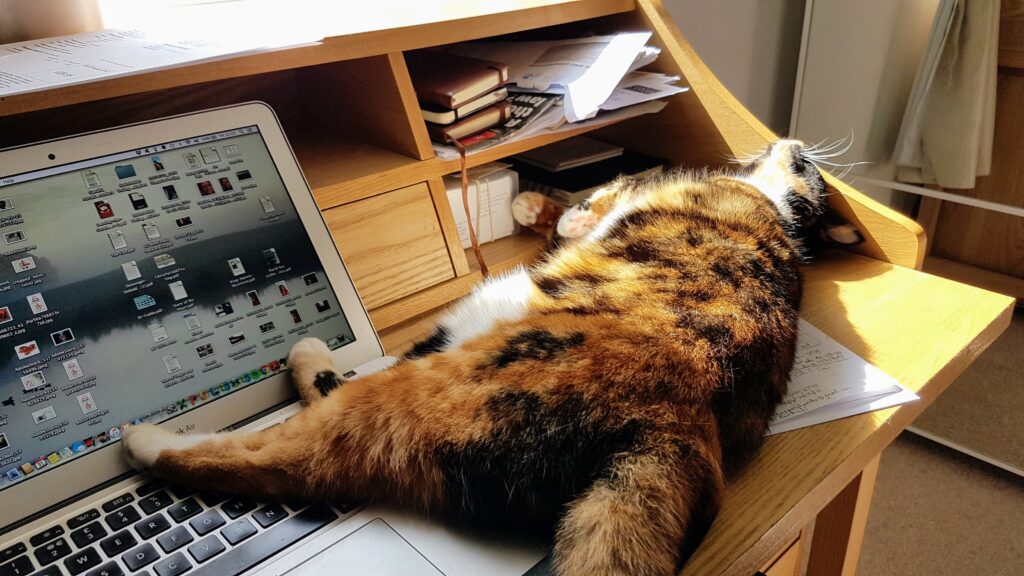
Six o’clock in the morning and I feel a light bump on my belly. Edie has jumped onto my lap for her morning greetings with some friendly chirrups as she jumps. Edie is a cat, in case you’re wondering. Then she settles down on my tummy with a powerful deep purring, the vibrations reverberating pleasantly through my body.
My eyes still usually tightly shut, I reach out and give her a few strokes, my energy flowing through my hand as I stroke her in her favourite way, sensuously reaching just under the side of her chin.
This ritual happens every day and it is always completely fresh and exciting for Edie, as if this were the original ‘morning has broken, like the first morning’. She purrs away happily and never gets bored with this ritual. And although I’m not quite as fresh as Edie at 6am, it’s also a fresh moment for me too.
It’s a nice way for me to wake and be simply present and still with her, as I am lying in bed and coming to. She sits there purring, in her sphinx pose, unmoving yet not sleeping, transmitting a sense of undivided presence.
Incidentally, purring is not only therapeutic for cats but has therapeutic benefits for humans too: the low frequency vibrations of purring decrease blood pressure, alleviate stress and can even aid in healing.
As philosopher John Gray says in his, Feline Philosophy, Cats and the Meaning of Life,
Unless they are confined within environments that are unnatural for them, cats are never bored. Boredom is fear of being alone with yourself. Cats are happy being themselves; humans are happy by escaping themselves.
Dogs, of course, are much more exuberant than cats and their simple enjoyment of being alive is very striking. When I’m out on my daily walk, I meet all kinds of dogs who are overwhelmingly excited and happy to be going on walkies: sniffing every nook and cranny, straining at the leash, happy to meet me, and racing madly around the local field when let off the leash. This is a repetitive daily event, yet for the dogs it seems the very best moment of the best day of their lives.

Philosopher Mark Rowlands, inspired by his own dog’s boundless happiness on his repetitive walk every day, has this to say in his book, The Happiness of Dogs,
Finding meaning in life is hard for us, but easy for dogs. Meaning in life exists wherever the love of life emanates from a nature that is whole and undivided. Being undivided by reflection, being whole and entire, a dog has only one life to live, whereas we – in whom reflection’s canyon is deepest – have two. For us, there is both the life that we live and the life that we think about, scrutinise, evaluate and judge.
A dog will inevitably love its one life more than we love our two lives. Meaning in life is easy for dogs – and hard for us – because meaning is simply the joyful expression of a nature undivided against itself.
Mark Rowlands asserts that the schism in human consciousness which we call reflection, prevents the happiness that is connected with being whole, and that this schism breaks us in two. While there is considerable truth in this, I am convinced from my own experience that it does not have to be quite like this for us humans.
Like my canine acquaintances who I meet while walking each day, I sniff the air (though not the lampposts), I look around me wide-eyed, enjoying just walking, undistracted from anything else. I’m aware of the trees, the birds singing, the breeze on my skin and at the moment, the rich scent of lime blossom.
I’m present and even if the walk is merely round my urban block, it’s always just as new and fresh. And thoughts arising need not be a distraction or be cause for a sundering into two lives as Rowlands suggests; mental activity is part of nature too.
Now, of course I don’t bound exuberantly about, and don’t have that endlessly and delightfully naive excitement that dogs have, yet I am not divided nor bored. I’m awake. The ability to reflect needn’t necessarily split us. Reflection is a wonderful capacity that is so well developed in human beings. The issue is only if we obsessively abstract ourselves from our actual surroundings, to think about things in isolation.
With long practice, I’ve found that the balance can be shifted from habitual, knee-jerk reflecting, to being simply present, aware of what I am seeing, smelling, hearing and feeling. This isn’t some kind of rote mindfulness practice, but rather a gravitational attraction to being present, arising out of a deepening love of Life and all its myriad manifestations.
We intuitively recognise this simple undivided presence in cats and dogs and other animals. In spite of our cognitive prowess, we are not really so different from other animals that we cannot also abide here as our true nature. And for us human animals, reflection and self awareness can then come to be a blessing.
Much of human life is a struggle for happiness. Among cats, on the other hand, happiness is the state to which they default when practical threats to their well-being are removed. That may be the chief reason many of us love cats. They possess as their birthright a felicity humans regularly fail to attain.
John Gray, Feline Philosophy: Cats and the Meaning of Life