

Carl Jung’s Bollingen Tower
“People are no longer involved in nature and [have] lost their emotional participation in natural events, which hitherto had a symbolic meaning…Thunder is no longer the voice of an angry god… No river contains a spirit… no snake the embodiment of wisdom, no mountain cave the home of a great demon. No voices now speak to man from stones, plants and animals, nor does he speak to them thinking they can hear. His contact with nature has gone, and with it has gone the profound emotional energy that this symbolic connection supplied.”
Carl Jung
By chance, I came across the above quote by Carl Jung, and it greatly intrigued me, given my passion for nature, animism and becoming whole.
Jung believed that modern society’s detachment from nature has led to our psychological imbalance and he advocated for our reconnecting with the natural world to bring about wholeness and to facilitate self-discovery. He saw nature as deeply intertwined with the human psyche, helping to ground us and providing connection to the collective unconscious. Jung felt that because of our losing this communication with nature, the emotional energy which it generated has sunk back into the unconscious.
I am grateful to author Dr. Susan Mehrtens, who has drawn out many nature references from Jungian archives in her essay, Jung on Living as Part of Nature.
In recent years, Jung has attracted new attention for his environmentalist insights about the psychological dimensions of the human relationship with nature. Almost a century ago, he was already concerned about the tremendously damaging psychological effects of the modern world’s fast-paced, technologically driven, environmentally destructive trajectory.
He referred to nature as “Mother Nature, the great-grandmother” and said that nature is “a whole essence with a soul”, and she is “not matter only, she is also spirit.”
Although he never referred to himself as such, he is now sometimes viewed as a “nature mystic” since he felt such an overwhelming kinship with the whole of the natural world and derived direct psychospiritual energy from it.
Jung lived an intentionally simplified life in the home he built for himself, Bollingen Tower, on the shores of Lake Zurich, without electricity or running water. He chopped wood and fetched water, all part of his psychological work and the pursuit of individuation, an aim central to Jungian psychology. For Jung, the tower was a place to reconnect with nature in this lakeside setting.
Jung felt we needed to “get back to a condition where we are right with nature,” and so to live as a part of nature. And for Jung, to live right with nature meant to become free of the “rationalistic walls” which keep us “hemmed round,” cutting us off from the rhythms of nature and a quality of eternity which indigenous people understood. He said that science has “de-spiritualized nature through its so-called objective knowledge of matter.”
This leaves us,
“Transplanted into a limited present, consisting of the short span between birth and death. The limitation creates a feeling that [we are] haphazard creatures without meaning, and it is this feeling that prevents [us] from living life with the intensity it demands if it is to be enjoyed to the full. Life becomes stale and is no longer the exponent of the complete man. That is why so much unlived life falls into the unconscious.”
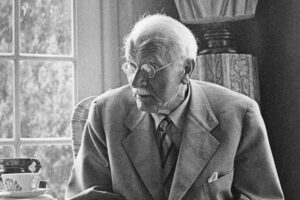
Jung
Although Jung was very critical of modern people’s lop-sidedness in regard to our hyper rationalism, calling it nothing more than “enlightened stupidity”, he recognised that we need a middle way, combining both science and spirituality.
Interestingly, he held that it can be done either from within or without: letting nature touch us, or going deeper into ourselves in our dreams.
“It can be done within or without. Walking in the woods, lying on the grass, taking a bath in the sea, are from the outside; entering the unconscious, entering yourself through dreams, is touching nature from the inside and this is the same thing, things are put right again.”
I’m finding great resonance in the work of Carl Jung and especially in how it relates to my interest in indigenous worldviews. Although we moderns can never hope to truly understand or enter into indigenous worldviews such as the Aboriginal Dreamtime, I’m struck from my studies, of how important dreaming is in indigenous cultures all over the world.
For example, I’ve recently read, We Will Not be Saved, by Nemonte Nenquimo, an extraordinary true story of an indigenous woman born into the Waorani tribe of Ecuador’s Amazon rainforest. She grew up imbibing the knowledge of foraging, plant medicines, story telling and the importance of dreaming. Dreams are a crucial guide to life in their world and the dreams and premonitions of the tribal elders are especially valued.
As a teenager Nemonte was sent out of the jungle to an evangelical mission in the city, where she encountered the modern western world and endured considerable abuse and trauma. After a few years, her ancestors began appearing in her dreams begging her to return to her own culture.
She did so, and has now become a powerful force in climate activism, taking on Big Oil and its destruction of native lands, and spearheading an alliance of indigenous tribes and securing legal victories in defence of their lands.
Dreaming is still important in her work and I noticed that she writes of how she found it hard to find any access or direction in dreams when she was super busy in activism and travelling in different cities, and how she longed to return to the sanity of her village where she could dream.
As well as this access to dreaming, in her descriptions of life in the rainforest, it is very clear that the people, and especially the elders and those who have kept most closely to the old ways, have, what are to to us, extraordinary sensory abilities and premonitions, because of their “living right with nature”, as Jung would have put it.
She paints a vivid picture of how indigenous people, and particularly the elders and shamans, tap into what could be called the collective unconscious of the forest.
Jung found through experience that he could come to trust his intuition and that he could trust Nature herself. This guidance of his own instinct “leaves Nature to answer out of her fullness,” and the way forward in his psychological practice with clients would reveal itself in their dreams, fantasies, visions and sometimes in synchronicities. This way of approaching decisions all sounds quite familiar if you read various accounts of indigenous cultures.
Not having an in-depth knowledge of jungian psychology, I found his pronouncements on Nature quite revelatory. Jung was uncannily prescient in his diagnosis of what ails modern society, decades before this kind of critique became more widespread. And Jung, as I outlined above, does offer remedies for our predicament.
We Will Not Be Saved: A memoir of hope and resistance in the Amazon rainforest
by Nemonte Nenquimo
https://guardianbookshop.com/we-will-not-be-saved-9781472289247/

4 responses
Nice one Chris. I can appreciate what he says about reconnecting with nature from the outside. Here on the cliffs in Devon, sleeping beside Ocean in all her moods, attuning to her rhythm, or walking the undercliff walks and feeling the green lushness of life, and paddling out in the rolling sea all restores my soul…I feel our culture’s post modern life very unhinged and confused, on the verge of insanity, lacking roots or dimensionality.
Thank you Chris. I was unaware of the depth of connection and insight from that connection to Nature of Carl Jung. This and the parallel significance of dreams in Indigenous cultures, opens up a dimension of his work (for me) and its relevance & meaning in our typical contemporay modern lifestyles. It reveals both a loss far deeper than that of the simple aesthetic pleasure of being in or connected Nature, as well as a remedy, as you say.
Thank you for a beautifully, thought provoking essay.
“Walking in the woods, lying on the grass, taking a bath in the sea, are from the outside; entering the unconscious, entering yourself through dreams, is touching nature from the inside and this is the same thing, things are put right again.”
Love that Chris, touching nature from the inside! Having recently spent an extended period in a remote place of natural beauty, away from urban life, it was confirmed and reconfirmed how the rhythm of nature, day and night, whispers a secret about the nature of all things, including ourselves. Everything comes and goes and this is how everything exists and is sustained….
Beautiful and informative. It would be good to have the original German text. I’ll bet there are nuances that get lost in translation. Depending on how nature is defined (German 🙂 I would say that connecting with nature from the inside doesn’t only need to be through dreams and meditation, unless Jung means cosmic or ‘personal inner’ nature. Since nature and all its family members (trees, rivers, etc) are numinous, one can simply connect as one would with another human or a dog. Merely connecting with the outside of a dog, and consequently also a tree or whatever, wouldn’t make sense.