Eco-redevelopment of dockside in London
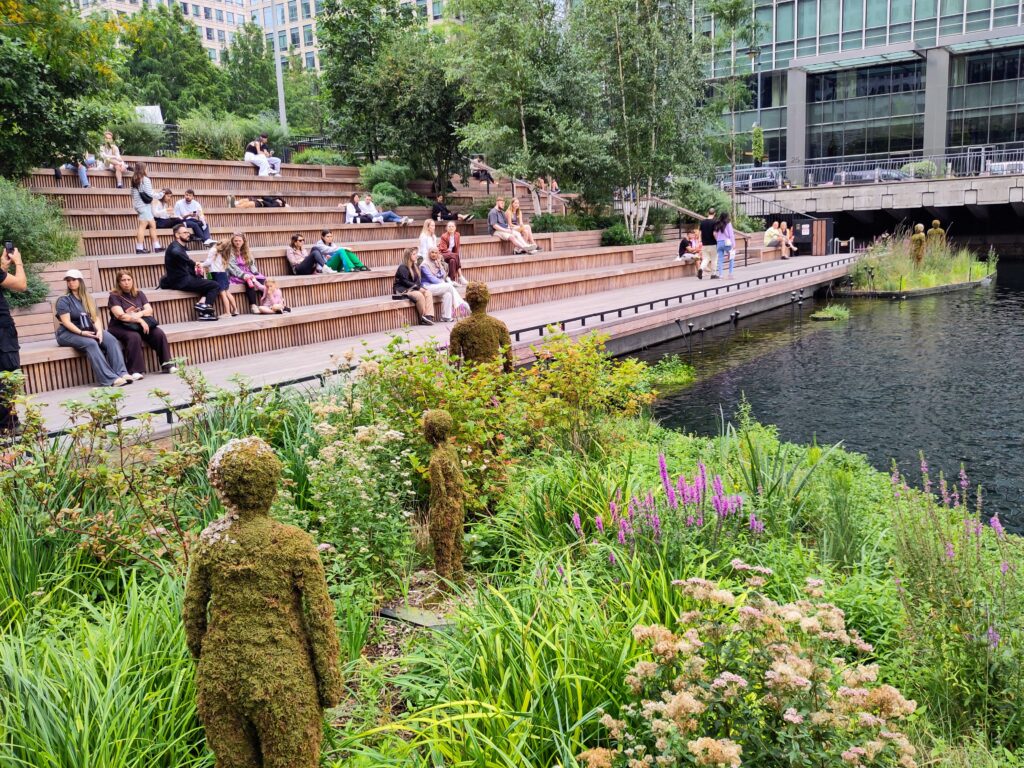
I often walk past the new eco-oasis called Eden Dock in the high rise London Docklands, pictured above, made by the Eden Project, a pioneering ecological organisation. It’s undoubtedly a very big improvement on the previous bare concrete dock walls, with its lush plantings and wooden seating for people next to the water. The stated aim is of “a shared vision of enhancing biodiversity and re-connecting people with nature”.
So I’m very glad to see these changes, yet at the same time, when I walk past, I can’t help reflecting on how unwittingly humancentric this project appears to me. A grandstand of seating for people dominates the scene with many green humanoid figures dotted around the dock; made of living plants, they are to show “nature and people living together in harmony.”
I think there could have been a much better provision for nature rather than being very largely human focussed – especially when the ostensible aim is to increase biodiversity.
This made me reflect on how in general we are so unthinkingly and narrowly humancentric. This is very understandable in our modern human dominated world, but I think that it is actually quite one sided and acts to our detriment in the longer term .
Our culture is steeped in human exceptionalism, the assumed belief that humans are fundamentally different from, and morally superior to, all other living things, as well as being quite distinct from nature.
I’m not suggesting that we should attempt to flip to the opposite and somehow disparage ourselves. After all, it’s only natural that we think first of our family, our tribe, our society and our human species; yet if our view is circumscribed only by this, I would say that our perspective and reality is impoverished.
Let me explain what I mean and this will necessarily involve a bit of a digression to provide the necessary context, before circling back to my summation on humancentrism.
We live on a planet immensely rich with a myriad network of non-human inhabitants: from trees who provide us with life-giving oxygen, to the innumerable plants and animals who sustain the environment and who give their lives to sustain us. In times past, this relationship was honoured and respected by peoples who were naturally much more directly connected with earth processes.
In the modern world we are ever more disconnected from the networks of life and our attention is increasingly captured by a digital and virtual world.
Scientists now say we are exiting the geological age of the Holocene and entering the era of the Anthropocene – which means the new reality where human activity is the dominant influence on the climate and environment. The downside of this new term, Anthropocene, is that in effect, it sets humans as outside of nature and in control, holding the reins of the Earth. In this Brave New World, there is no space for the more-than-human world, and if you think about it, the Anthropocene is actually a rather unwittingly arrogant view.
Although it is true that human activity is the prime cause of ecological collapse and climate breakdown, a better and more appropriate term for our current era, the Humilocene, has been suggested by cultural anthropologist, David Abram. Embracing the Humilocene as being our current era, points us back to the terrible destruction we have wrought to innumerable fellow beings and to the biosphere; and it points to our needing humility and to be humbled by what we are doing.
Being humbled by our actions is a necessary corrective and prelude to our hopeful restraint going forward. This is an important aspect of reappraising our unrecognised humancentrism. In fact, I would say that integrating this kind of humility is an important aspect of what it means to be fully human today, in the modern West. Growing out of our ingrained pedestal thinking is a big step towards a wider, more inclusive sense of being human.
Our unwitting anthropocentrism is largely unrecognised. Just think of the dominant factory farming of billions of animals for our food; it’s a cruel, industrial treatment of fellow feeling beings, which can be compared to life in concentration camps. It’s a long way from the traditional and more humane small-scale farming of old. Or consider how non human beings have still not been accorded virtually any animal, plant or river rights, though this is very slowly changing.
Yet in reality, we are of course not separate from our fellow beings in the way our common attitude of today would suggest. The late great Vietnamese Buddhist teacher, Thich nat Hanh, coined the term interbeing, which points to the fact that everything exists in a state of interconnected being, a state of being interwoven and mutually dependent.
In cutting edge human potential groups, interbeing is being increasingly embraced as a wider foundation for dialogue and developing a deeper and creative field between groups of participants. This is undoubtedly a beautiful and fruitful approach which goes against the current of seeing ourselves as separate and isolated. From my point of view I would suggest expanding its practice even wider, by not primarily thinking of only human relationships; rather to embrace interbeing as being the very substance of being alive and our entanglement with all of life. What about a Gaian interbeing? This points to a quite different sense of being human.
From my perspective, part of our modern sense of being human is to be overly focussed on the mind and consciousness, while treating matter as if we were somehow outside it, in a strangely detached, aloof manner. We need to accept our bodily reality in order to more deeply reconnect with the rest of life. This is because the more I identify with this body, the more I discover my entanglement in a more-than-human world, since the body is our access to other beings.
Through sight, hearing, touch and taste, we relate to the bodies of foxes, magpies, swans, buzzing wasps and the trees and plants that we eat for food. In the autumnal sun, I stand transfixed watching a three dimensional swirling ballet of small hoverflies cavorting about with each other with extraordinary flying skill and speed.
I find I’m most real when in relationship with other creatures and beings.
As David Abram says,
“To identify ever more deeply with my creaturely flesh is a very subversive move indeed, affirming my embedment in a more-than-human community. It is a most powerful way of coming to our senses, beginning to taste the world with one’s tongue, to hear and attune to the speech of other beings.”

To touch is to be touched
So-called ‘nature’ is not an add on, it’s the reality in which we live and breathe.
For example, consider interbreathing: the amazing reciprocal basis of life where we breathe in and are nourished by the oxygen which the plants breathe out and vice versa. We breathe in oxygen that was woven by algae, trees, plankton, ancestors. We’ve never breathed alone.
In case you think that I may be some kind of misanthrope, privileging animals and seeing humans as pests who only destroy our beautiful shared home, let me reassure you that is far from the case. And archaeological evidence is increasingly emerging which shows how we humans are a keystone species, just like we know the beaver to be, in how we previously managed landscapes with benefit for many other beings.
As an example of this keystone species activity, extensive forests of chestnut and oak in Eastern USA were planted and then managed by controlled burning by ancient First Peoples, and similarly on the West Coast, where they created extensive clam beds on the shores, ensuring habitat for many marine species in these ‘sea gardens’. We humans are meant to be here; we are an intrinsic part of the Life world.
To return to the original point of this essay, promising a fresh look at humancentrism, I’m realising that it’s not a simple issue of becoming less humancentric. That’s because being humancentric depends on what we think of as the meaning of being human. If our sense of being human is expanded and becomes more inclusive, then it’s not so much a matter of being less humancentric, as inhabiting a fuller and more inclusive sense of being human.
I find that my being is expanded and deepened in relationship – with other people, yet more still with other beings of very varying and different forms, whether leafed, finned, furred or feathered, and including rivers, seas, winds and mountains.
Humancentric wouldn’t be the problem that it is, if our sense of being human enlarges to what I believe is its fuller sense, where interbeing with all life is included, a full spectrum interbeing, embodied and relating through all our senses. In fact, how can we really be most fully human without relationship with our much wider family and ancestors?
Our times are calling for a Gaian consciousness.
One Response
Beautiful inquiry Chris!