
The notion of being a pilgrim has resonated with me from way back in my school days when in Morning Assembly, singing hymns was part of the daily occasion. Though often bored by words I couldn’t make sense of, one hymn in particular did rouse me. It was ‘To be a Pilgrim’, the tune set to the words of John Bunyan, the 17thC author of ‘The Pilgrim’s Progress’. The lyrics of adventure, bravery and quest, spoke to something in me, though I couldn’t have explained it back then. Pilgrimage has been with me as a kind of undercurrent throughout my life.
A pilgrimage is classically thought of as a journey to a holy place, which can lead to a personal transformation, after which the pilgrim returns to their daily life. It is usually a journey to a shrine or other place of importance to a person’s beliefs, although sometimes it can be a metaphorical journey into someone’s own beliefs.
For many centuries the main destinations for Christian pilgrimages have been Jerusalem, Rome and Santiago de Compostela, and in times past, this was a long and sometimes dangerous quest. For Muslims, the Hajj to Mecca is one of the five pillars of Islam to be carried out at least once in a person’s lifetime if at all possible. Pilgrimage has played a part in all religions.
Today’s more secular world has seen the growth of the cultural pilgrimage which, while involving a personal journey, is not religious in nature. For example, this might be journeying to an iconic place with cultural significance such as visiting Liverpool to see sites associated with the Beatles.
Pilgrimage is clearly still meeting a human need – and perhaps a growing need in our times of alienation and lack of groundedness. The popularity of the British Pilgrimage Trust (BPT) attests to that. It advocates for pilgrimage for mental health, to find meaning in historical sites, and to connect with nature and the land. Guy Hayward, co-founder of the BPT says that at the heart of every pilgrimage lies an irresistible pull towards the unknown.
And he distinguishes the archetype of the pilgrim, who is driven by an inner urge to step into uncertainty guided by intuition and a true heart, from the tourist who usually travels to see what is already discovered.
As a young man, I embarked on a journey to the East, a phenomenon which was popular among a certain subset of disenchanted young Westerners in the late 60s and early 70s. Like many others I set out to India with a spiritual thirst in my heart which at that time, I didn’t know how to quench in my comfortable yet secular homeland. Looking back, I realise that this was a classic pilgrimage too, though I wouldn’t have thought of that term back then. This journey proved to be pivotal to my future direction and purpose and as one measure of its impact, many of my closest friends today were fellow pilgrims who I met on the road in India decades ago.
Hermann Hesse’s novels were essential reading for myself and my fellow travellers and I can’t put it better than Hesse’s own description of this kind of pilgrimage in his short novel, The Journey to the East (1932),
For our goal was not only the East, or rather the East was not only a country and something geographical, but it was the home and youth of the soul, it was everywhere and nowhere, it was the union of all times.
Hermann Hesse
Yet pilgrimage can be much shorter and closer to home and still meet an important need.
I regularly take part in day hikes, either alone or with small groups, walking various symbolic paths or heading for an auspicious destination. For example, walking to a major cathedral like that of Canterbury from an outlying village along paths trodden by pilgrims for many centuries, invariably brings the ‘hike’ to a deeper level, walking in the footsteps of our ancestors. You may even feel the land being re-sacralised.
Day pilgrimages embarked upon with a spirit of devotion and dedication, open you up to new possibilities. Pilgrimage to me, helps transform walking into a spiritual practice, a moving meditation. Anyone who has practised traditional sitting meditation knows how easily you can become completely distracted and lost in your thoughts. Whereas with pilgrimage walking, you just keep walking whatever may come up in your mind; over time it tends to put your thoughts in more perspective because you keep going regardless and are grounded in the real world, in the land. No wonder this practice has endured for so many centuries in many varied cultures and religions.
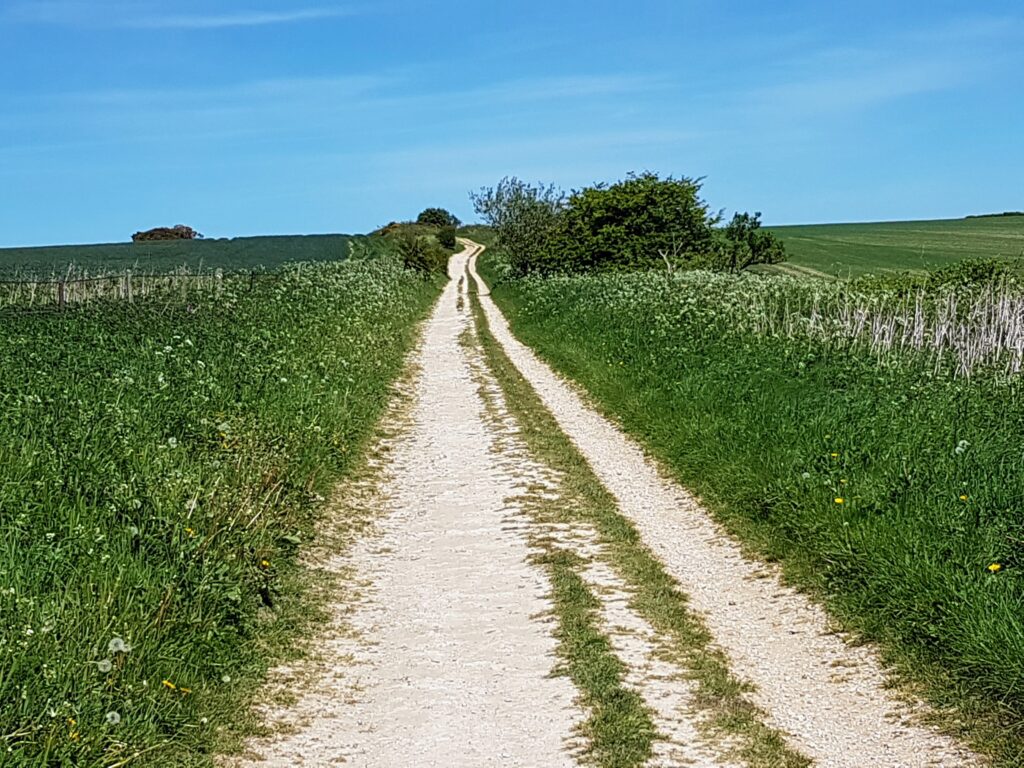
For example, I’ve hiked many long miles on The Ridgeway, probably the oldest path in Britain, and trodden for over 5000 years by Bronze and Iron Age travellers. It follows the crest of a range of hills across southern England and for me this is a pilgrimage. In the summer sun, I’ve found myself so absorbed in just walking mile after mile after mile along this ancient chalk trail, that I seem to cease to be a walker and become part of the whole totality.
A famous hiker expressed it most beautifully. This is Nan Shepherd, who wrote an extraordinary short book, The Living Mountain in the 1930s about her lifelong hiking in the unforgiving Cairngorm mountains in Scotland. I would call her a true pilgrim. She set out not to conquer peaks but to enter into the life of the mountain plateau with reverence.
Walking thus, hour after hour, the senses keyed, one walks the flesh transparent. The body is not made negligible, but paramount. Flesh is not annihilated but fulfilled. One is not bodiless, but essential body…… I have walked out of the body and into the mountain. I am a manifestation of its total life, as is the starry saxifrage or the white-winged ptarmigan.…….It is a journey into Being.
Nan Shepherd
Pilgrimage can be of any length. Each year I always make a day journey to a secluded place out of the city where I can listen to the now rare Spring song of Nightingales, newly returned from warmer climes and this for me is my annual Nightingale pilgrimage.
The destination isn’t really the point and the journey isn’t linear; pilgrimage is a way of being. On the classic Camino de Santiago pilgrimage in Spain, it’s not at all uncommon for pilgrims to feel a big let-down once they have arrived at the cathedral, if they had held the destination to mean the be all and end all. The real value of their pilgrimage may reveal itself later and many pilgrims are not clear at the outset as to why they are even doing it.
We are not journeying only through physical landscapes, but also through the unknown landscape of the soul. True pilgrimage of the heart never really arrives at a destination; the ‘destination’ is a new beginning. Ostensibly, of course there’s often a goal, a destination, and that has its place too, yet the reality of pilgrimage is more than that.
I feel that one of the key elements contributing to true pilgrimage is humility. In our modern times, the notion of humility sounds antiquated, yet I feel it couldn’t be more deeply relevant. At its simplest, humility is recognising that fundamentally, life and your journey is not primarily about you, but rather about the whole of this vast mysterious existence.
We’re not in control of everything and cannot know everything; new possibilities can only reveal themselves to us when we let go of arrogant certainty. This was undoubtedly the spirit of ancient Christian pilgrims on their knees to God, and is also that of indigenous journeyers with their reverence for the land. Poet Gary Snyder speaks of hiking/pilgrimage shifting our focus from ego-driven doing to spirit-filled being in nature. He says that, Walking is the exact balance between spirit and humility
And treading mile after mile on pilgrimage with sincerity and respect, can start to shift habitual self-centred perspectives.
Pilgrimage is an act of devotion. In its spirit you are acknowledging and honouring the land, our ancestors, all beings, life itself, as you tread.
I’ve come to think of life itself as a pilgrimage.
Let me finish with a quote from the late Father Charles Brandt, a hermit-priest who lived until his recent demise in seclusion in the forests of Canada. To me, he combined spiritual practice and walking into the essence of a pilgrimage without a destination.
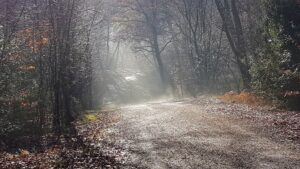
It is early morning with its quiet coolness. I walk out the old logging road. … The logging road along with other trails through the forest is where I practice walking meditation. I do not think of the road as leading anywhere. It is the road to nowhere, the path on which I journey and have been journeying for a lifetime. Although it is the path to nowhere, in reality it is the way to everywhere, because it enables me to enter into communion with the whole community of beings.
4 responses
Beautifully written piece, Chris, with a profound message.
Nice you mention Nan Shepherd, I’ve come across her recently in Robert Macfarlane’s The Old Ways. Im also considering the recent 108 day journey from Texas to Maryland by the Therevadan buddhist monks – where every step for them was a meditation on peace as they walked along B roads and gathered media attention along their passage. And I consider my own journey along with 4-500 others across the USA in ’86 calling for global nuclear disarmament. While it was called a march, it was really a walk, and then it was more of a pilgrimage, both into ourselves and to discover our country and her peoples along the way.
While pilgrimage has a goal, it seems really pilgrimage is more importantly about the Way and intention…
Wonderful Chris, thank you.
As I walked along the path of your sentences, each word a step followed by another I wended my way along side you in your story and the invitation to accompany you. It appears as a linear tracing, reading from left to right and down the page, as indeed it is, a form of a pathway. Yet the linearity of the sentences and story weaves and blends into a widening and expansion that releases us from the linearity of the path.
I traced the meaning and origin of the word pilgrim, which comes from the latin ‘Peregrinus’ meaning ‘foreign’ (and also as in the falcon).
This led me to this music (influenced by ancient tonalities) : Tonus Peregrinus “wander on a musical pilgrimage of revelation, letting ancient polyphony and living masterpieces sing into the listening heart”…
Much love as always..
A thought that always occurs to me about pilgrimage is that it involves being unencumbered by ‘baggage’ as in one’s familiar cultural, familial or territorial environment, thus leaving one more open and available to the new experience. I was recently reminded of this while rereading ‘The Snow Leopard’ by Peter Matthiessen.