

Ahimsa is an ancient Indian concept dating back several thousand years to the time of the Vedas and Upanishads. It’s been a key virtue in Hinduism and Buddhism, and most especially in Jainism, which has taken ahimsa as the very heart of its beliefs and practice.
I felt drawn to write about a piece about ahimsa, since I realised that this term and the spirit behind it has become increasingly important to me over the years. In some way it is part of a backdrop to many of these blogs/essays of The Urban Animist.
Ahimsa is usually translated as non-violence or not harming, but while that is technically accurate – the Sanskrit ‘himsa’ meaning injury or harm, while a-himsa is its opposite, non harming – most exponents would likely feel that translation to be quite limiting.
The late great spiritual revolutionary and social activist Vimala Thakar, who I have had the honour of meeting and interviewing, said that ahimsa really means “creative love.” This is a much more active term rather than the passive sounding “harmlessness” of just abstaining from violence.
She emphasised how it is a misunderstanding to think of ahimsa in a way that suggests that violence is here, and then you are somehow going to cultivate non-violence in opposition to it. Rather it is creative love which can deal with the conditioned violence within each of us, which she saw as the heart of ahimsa.
This kind of understanding was strongly echoed by Thich Nhat Hanh, the late great Buddhist master. He said that ahimsa is not merely the passive absence of violence, but the real active cultivation of understanding and love to uproot the suffering that causes violence. And ahimsa then is opposing injustice without dehumanizing or attacking the oppressor. In fact,
Thich Nhat Hanh was once asked to summarise all of Buddhist teaching in one word and he said “ahimsa;” so that is an indication of the importance he placed on it.
I’m convinced that ahimsa is just as relevant today. I mean, there’s so many aspects to it. It’s about everything we do; it’s our attitude. It’s much more than just refraining from something. Ahimsa involves acting – and sometimes that might mean activism too – doing what you can to help and minimise suffering if possible. One prominent aspect of it is of course, our relationship with the living world and all our fellow beings.
Just last week, my wife and I noticed a skinny looking fox at the end of our inner London street. He had all the signs of mange, with a thin tail and patches of bare skin where his fur was missing: a condition which causes the poor fox to incessantly scratch away its fur until it dies after a few agonising months of gradually deteriorating. A single dose of a powerful medicine can completely cure an ailing fox, so we tracked the fox down and gave him the tablet in some cat food. Hopefully he should avoid that awful fate. It’s hard enough as it is, just being an urban fox.
This may seem to some of you like a stretch with how I’m linking more widely to ahimsa but I feel it also very much applies to cities. Cities need love too. As more and more of us now live in urban areas, part of my urban animist writing has been to explore how we can live in a sane and caring way as an inseparable part of urban nature.
I’ve been experimenting for years with guerilla gardening. In our very unloved and rubbish-strewn inner city street, my partner and I create flower beds around street trees and care for them, which brings smiles and happy comments from passersby and locals.
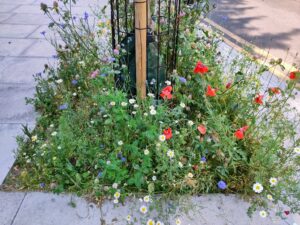
Speaking of foxes, another local fox insists on digging holes in our flower beds, and she even took away the sign we had placed there which asked people to not let their dogs dig up the plants. The fox did this immediately after we’d put out the sign and we watched her, in amazement, as she trotted off with the sign in her mouth.
It’s only natural when we open our hearts and minds, to extend care to the environment and the world around us, and to begin to adjust our way of life to be more in tune with a world where all might thrive.
In order to live, we can’t avoid harming other beings to a certain degree. And without eating plants, it would be impossible to live. Obviously, a lot of people in the world have to kill animals to eat. They live with them and it’s the only way they can survive. I’m not suggesting that everyone should immediately become vegetarian, but it’s the attitude. It’s the respect shown to our fellow beings. It’s the recognition of the importance of all life and the honouring of it, even if animals have to be killed.

*The Illustration above featuring a hand with a wheel on the palm symbolizes ahimsa in Jainism. The wheel (Dharmachakra) is inscribed with the Sanskrit word “ahiṃsā”
But if you live in the relatively affluent West, the main thing in my view, is to avoid ‘produce’ from factory farming, those concentration camps where chickens and pigs, and increasingly cows too, have to spend their entire lives in degrading and cruel conditions. If you eat meat and dairy, you want to be sure you know its origin, and that that animal which has given its life for your nutriment has had a decent life, and has been able to be outside and have space.
I think veganism is often misunderstood by being seen as a rather faddish or extreme kind of diet, a lifestyle choice, and one that’s been in fashion recently in the West.
But this isn’t the way I see it. For myself, it’s not really a diet at all. It’s an ethical stance towards not wanting to harm – and deeper than that, of love – because you feel the connection with other living beings, and you have no wish to unnecessarily harm or take the life of any other being just because it pleases your taste buds. And In our modern Western world, if you’re fairly affluent, there’s no need to do that and there’s plenty of healthy alternatives.
I find that as I open my eyes to the mounting polycrises we are in the midst of, and become less fixated on my personal story, then there is an ever growing need for the kind of creative love which is ahimsa. Yes, I know it’s all too much and I’ve previously been way down the vortex of climate grief and anxiety. Yet I find that if I remain rooted in where I actually am, and in a way, surrender to the reality, then there is much that I increasingly realise that I can do, in ways which may seem small, but contribute to wholeness and coherence.
I’m reminded of the famous quote of Nobel physicist Ilya Prigogine,
When a complex system is far from equilibrium, small islands of coherence in a sea of chaos have the capacity to shift the entire system to a higher order.
Though it can seem that we have very little power to change anything for the better, actually once we start looking more closely, there are many things we can do. Just to mention a few: we can switch our energy supply to renewables; move our savings and pension to sustainable green investments; buy organic produce to support regenerative agriculture; cut down on flying, and many other actions to live more lightly and more equitably on the earth. This is nothing to do with renunciation or asceticism, but rather out of care and love for our greater home and all our fellow beings.
Let me finish with a beautiful expression of ahimsa from the “Western Inscription,” a famous saying from the 11th century Neo-Confucian philosopher, Zhang Zai,
Heaven is my father and Earth is my mother, and even such a small creature as I finds an intimate place in their midst.
Therefore that which extends throughout the universe I regard as my body and that which directs the universe I consider as my nature.
All people are my brothers and sisters, and all things are my companions.

11 responses
Reading this, I was reminded that Ahimsa may begin long before any action. It begins in perception. The moment a river is no longer a resource but a living presence, the moment a bird becomes a neighbour rather than an object of observation, our way of being in the world starts to change.
For me, Ahimsa is closely connected to wonder, attentiveness and dialogue with the more-than-human world. Thank you for articulating this path so clearly and gently. Essays like this help cultivate the conditions for a culture of relationship rather than separation.
Perhaps the challenge of our time is to deepen perception before expanding capability. We are living amid the degradation of both ecosystems and social bonds. What is needed is not merely more powerful technologies, but a renewed capacity to encounter the world as a living presence: in its beauty, its resonance, and its fundamental unavailability. From such encounters, different forms of knowledge, responsibility and innovation may emerge. The question is not what technology can do, but what kind of attention should guide it.
We do not lack innovation. We lack forms of attention capable of meeting a world that cannot simply be optimized, predicted or controlled.
Thank you for your very congruent reflections.
As you say, wonder and attention are key to a very different way of being and relating to our world as living presence
Thank you for such a thoughtful piece. It touched my heart and put a smile on my face.
My cognitive capacities are not so active at this time, as I would love to express more why this piece touched me so much… I guess it is the deeply positive interpretation of the word ‘ahimsa’ that reminds me of the source of who we are and why we are here. ‘Creative love’ in Vimala Thakars’ words to me describes our Being (Love) and our deeply positive direction/ movement/ action in life (Creating) from who we are in essence… whether these are grande or small actions/ creations.
Thank you Monique. Your cognitive capacities seem to be working just fine to me!
Love your article, Chris. As always, gently pushing a saner, more profound view…
Sounds like your sign grabbing fox was a natural born iconoclast.
“a natural born iconoclast” :). Made me laugh Caprice, the definition of a fox…
Thank you Chris, for a beautiful and educational soliloquy. I love to read your authentic reflections and find that they often intersect with my own contemplations, either overtly as a topic or more often running in the background whilst active and engaged.
‘Creative Love’ has a refreshing quality and certainly resonates to me as a priority or direction.
In attuning to ancient wisdom there can, understandably and of necessity, be a lot of focus on oneself in order to cultivate a better, kinder more compassionate and effective form of self. What I have discovered in my own journey, is that the times when these ‘wisdoms’ emerged carried conditions and motivations that are not the same anymore – at least in a relative sense.
In the ancient time of the vedas etc, there was movement ‘away from the world’ for the first time in order to ‘go within’ and this gave birth to extraordinary human potentials and new horizons at the level of ‘consciousness’ .
All of this is still relevant (and still rarified territory), yet we find ourselves in a world increasingly incoherent and fraught – I think because of too much general detachment and separation from life itself, as ourselves, not just seeing the beauty of life but BEING it.
Creative love is indeed the potential dynamic answer to this. Your seemingly small examples of planting flowers and helping the fox are big because they show the way. I find myself less drawn to becoming a ‘mono-self’ of a certain desirable character but a kind of ‘chameleon’, responding as fully as possible to differing situations as seems fit.
‘Creative Love’ would by nature be dynamic and flexible and to me it makes sense that we need to be that also to be true to the spirit of ‘ahimsa’.
Thank you for generating a conversation around this..
Much love Patrick
Thanks Patrick for your insightful comments which completely resonate with me. I love it that our contemplations cross over and intersect on a regular basis. I’m kind of a chameleon too, responding to everything as best I can while not being overly inwardly or outwardly focussed – ‘Being Life’ as you put it, is something else altogether
❤️💙❤️💙❤️💙